Chemical Equity Initiative: chemicalequity.org
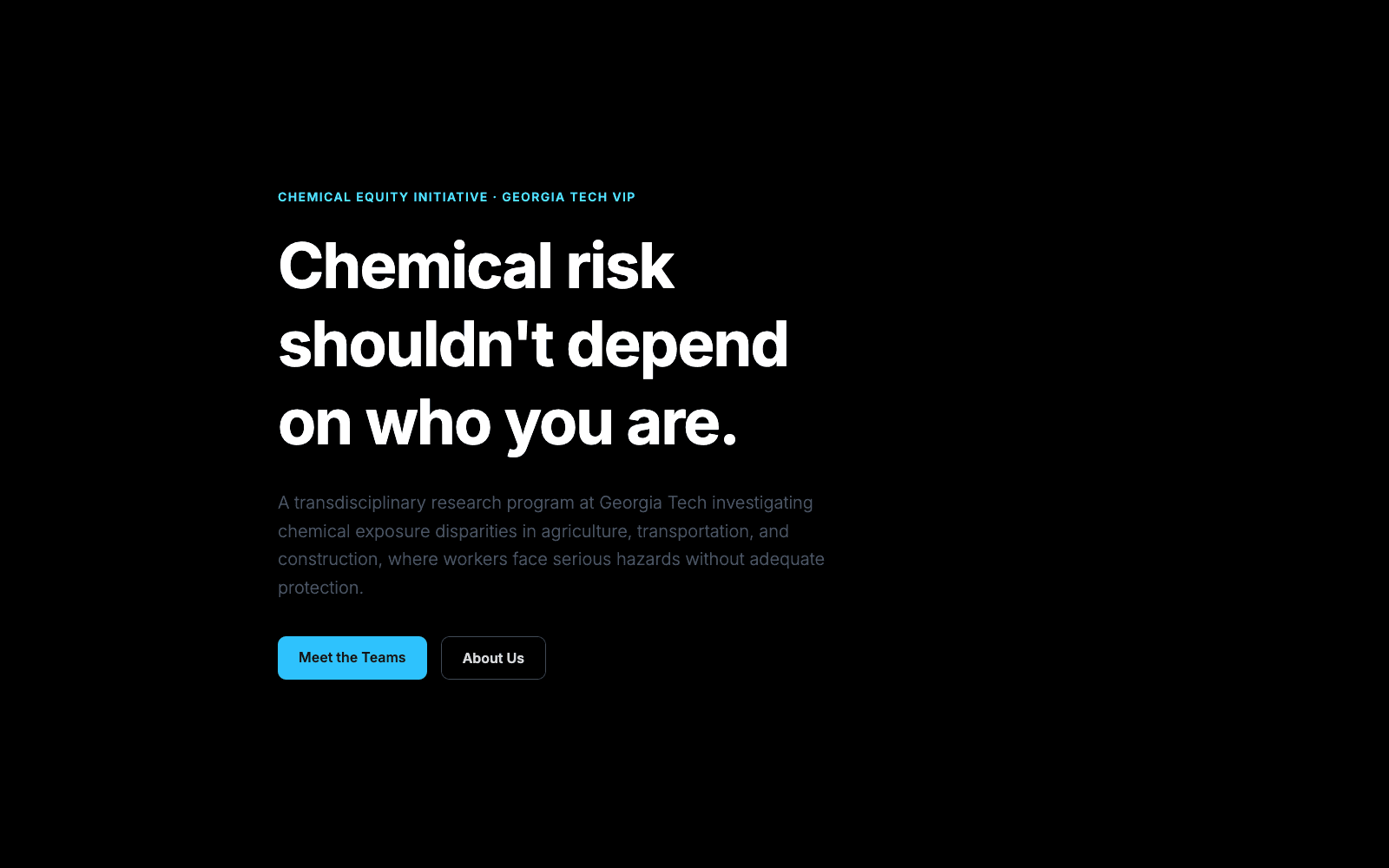
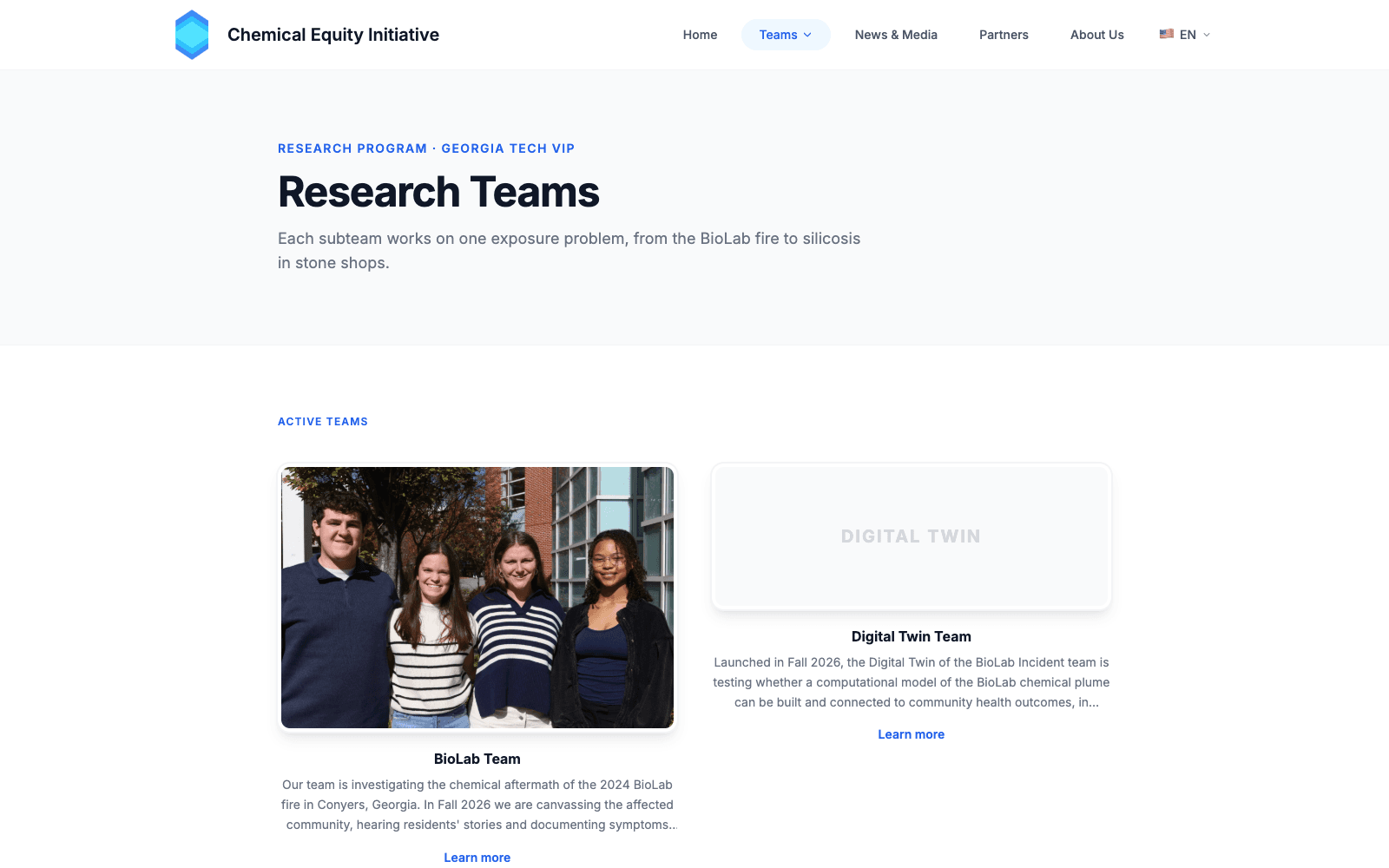
The public face of a Georgia Tech VIP research program investigating chemical exposure disparities, built from scratch and engineered to outlive its founder: the next student maintainer inherits CI, tests, a runbook, and a content layer that needs no code changes.
01 Overview
The site is a React 19 / TypeScript single-page app (Vite, Tailwind, React Router) serving the program's research subteams, people directory, publications, partners, and news pipeline. It is fully internationalized (English, Spanish, Chinese, and Portuguese via react-i18next) with a translation-parity check that fails the build when any language falls behind.
Because VIP teams turn over every semester, most of the engineering effort went into succession: GitHub Actions runs the production build and a Playwright end-to-end suite on every push, Dependabot keeps dependencies current, content lives as plain data files so roster and news updates never touch a component, and the README is a runbook covering routes, the design system, common changes, and domain management, written for whoever maintains it next.
02 Why this site exists: the BioLab fire
The fire that erupted outside my Georgia Tech apartment in late 2024, and put ninety thousand Georgians under shelter-in-place orders, didn't start with an unattended stove or an overloaded power strip. It started with a sprinkler head and water. In the hours before dawn on a Sunday at the BioLab plant in Conyers, a malfunctioning sprinkler head mixed water into a reactive medley of chemicals; by that afternoon, a plume of chlorine and bromine had closed I-20 in both directions. When I stepped outside, a thin haze made my eyes water and the smell of bleach and pool chemicals was everywhere. It was not even the plant's first fire.
In the weeks after, the news coverage focused on the freak chemistry of a fire caused by water. I kept getting stuck on a different question: knowing the science behind the reaction, who answers for it? A plant burns, not for the first time, while ninety thousand people close their windows, and the chemistry takes a sentence to explain while the accountability takes years. That question is what the Chemical Equity Initiative works on, and it is why the website matters: it takes peer-reviewed studies on exposure and harm and engineers them into something residents can actually find, read, and act on. The site has been central to the team's effort to interview and catalog the illnesses of Metro Atlanta residents affected by BioLab. The science only matters when it reaches the people and institutions who can do something with it. The site is also not my first build for the program; an earlier React Native app assessed chemical exposure risk across retail products.
The same question followed me back into my own field. The systems computer science builds, cleverly but not flawlessly, are creating the next generation of it: when a model flags a person and causes harm that no one can fully trace, who answers for that? It is part of why I work on interpretability. I want to be someone who can read the technical evidence.
03 Results
04 What was built
Founded and shipped. Designed and built chemicalequity.org end to end (47 of the repo's 49 commits), live on Vercel with push-to-main deploys.
Four languages. Full internationalization with react-i18next; an i18n parity script runs inside the build and fails it on missing keys.
Tested handoff. CI runs the production build and Playwright end-to-end tests on every push and pull request; Dependabot opens grouped weekly update PRs.
Content as data. People, teams, publications, and news are plain data files; future maintainers edit data, not components.
Documented succession. A runbook README covering routes, the design system, common changes, and domain management, written for the next student maintainer.